
Rédaction en anglais sur l’intelligence artificielle
Votre travail a été vérifié par notre enseignant : 8.08.2026 à 17:12
Type de devoir: Rédaction
Ajouté : 6.08.2026 à 8:17
Résumé :
Découvrez une rédaction en anglais sur l intelligence artificielle et comprenez ses usages, ses avantages et son impact en secondaire au Luxembourg 🤖
Artificial Intelligence: A Powerful Tool for the Future
Artificial intelligence, often called AI, is one of the most important inventions of our time. It is already present in many parts of our daily lives, even if we do not always notice it. When we use a smartphone, search for information on the internet, watch recommended videos, or speak to a virtual assistant, we are often using systems based on artificial intelligence. AI is no longer a distant idea from science fiction. It has become a real and powerful tool that is changing the way people live, work, learn, and communicate.
First of all, artificial intelligence can be described as the ability of a machine or a computer program to perform tasks that usually require human intelligence. These tasks include recognizing images, understanding language, solving problems, and making decisions. In the past, computers could only follow simple instructions. Today, with AI, they can analyze large amounts of data, detect patterns, and improve their performance over time. This progress has opened the door to many new possibilities in different fields.
One of the greatest advantages of artificial intelligence is its usefulness in everyday life. AI helps people save time and effort. For example, navigation apps can study traffic in real time and suggest the fastest route. Translation tools can help people understand foreign languages more easily, which is especially valuable in a multilingual country such as Luxembourg, where several languages are used in school, at work, and in public life. AI can also support students by offering personalized learning exercises and quick access to information. In this way, technology can make education more flexible and more accessible.
Artificial intelligence is also transforming the world of medicine. Doctors and researchers can use AI to analyze medical images, detect certain diseases earlier, and study large quantities of health data. This can help improve diagnoses and treatments. In hospitals, intelligent systems may assist medical staff by organizing information more efficiently. Of course, machines cannot replace the care, empathy, and judgment of a doctor, but they can become valuable assistants. Used responsibly, AI has the potential to save lives and improve the quality of healthcare.
In addition, AI plays an important role in the economy and the workplace. Many companies use artificial intelligence to automate repetitive tasks, improve customer service, and increase productivity. In factories, robots powered by AI can perform dangerous or tiring jobs. In offices, intelligent software can sort documents, answer simple questions, and help manage schedules. This can make work faster and more efficient. However, this development also creates concerns. Some people fear that machines will replace human workers and lead to unemployment. This fear is understandable, especially for jobs based on routine tasks. For that reason, society must prepare workers for change by investing in education, digital skills, and professional training.
Another important issue is the ethical side of artificial intelligence. AI is powerful, but power always comes with responsibility. If intelligent systems are badly designed or used without control, they can create serious problems. For example, AI can spread false information, invade people’s privacy, or make unfair decisions if it is based on biased data. Facial recognition technology and mass surveillance also raise many questions about freedom and human rights. Therefore, governments, companies, and citizens must work together to create clear rules. Artificial intelligence should serve humanity, not control it.
Moreover, AI raises philosophical questions about what makes human beings unique. Machines can calculate faster than us, store more information, and perform certain tasks with impressive accuracy. Yet they do not truly feel emotions, develop moral conscience, or understand life in the same deep way as humans do. They imitate some forms of intelligence, but they do not possess wisdom, compassion, or responsibility in the human sense. This reminds us that technology, no matter how advanced, should remain a tool created to support people, not to replace the human spirit.
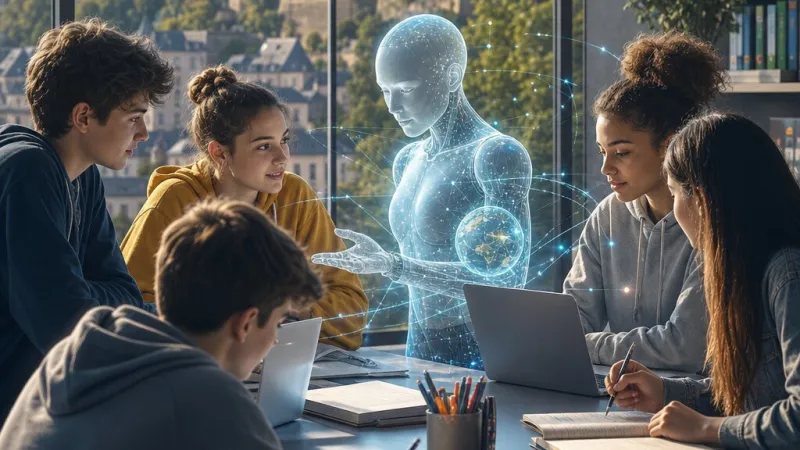
Young people, in particular, will grow up in a world strongly influenced by artificial intelligence. For them, it is essential not only to use technology, but also to understand it critically. Students should learn how AI works, what its limits are, and how to use it in an honest and intelligent way. For example, AI can help with research, language practice, or organization, but it should not replace personal effort, creativity, or independent thinking. Education must teach students to be both competent users of technology and responsible citizens.
To conclude, artificial intelligence is one of the most significant developments of the modern world. It offers many benefits in communication, education, medicine, and work. At the same time, it presents real challenges concerning employment, ethics, privacy, and human responsibility. AI is neither entirely good nor entirely bad. Its impact depends on the way people choose to develop and use it. If society uses artificial intelligence wisely, with clear values and careful limits, it can become an extraordinary tool for progress. The future of AI will not only depend on machines, but above all on the choices made by human beings.
Évaluer :
Connectez-vous pour évaluer le travail.
Se connecter